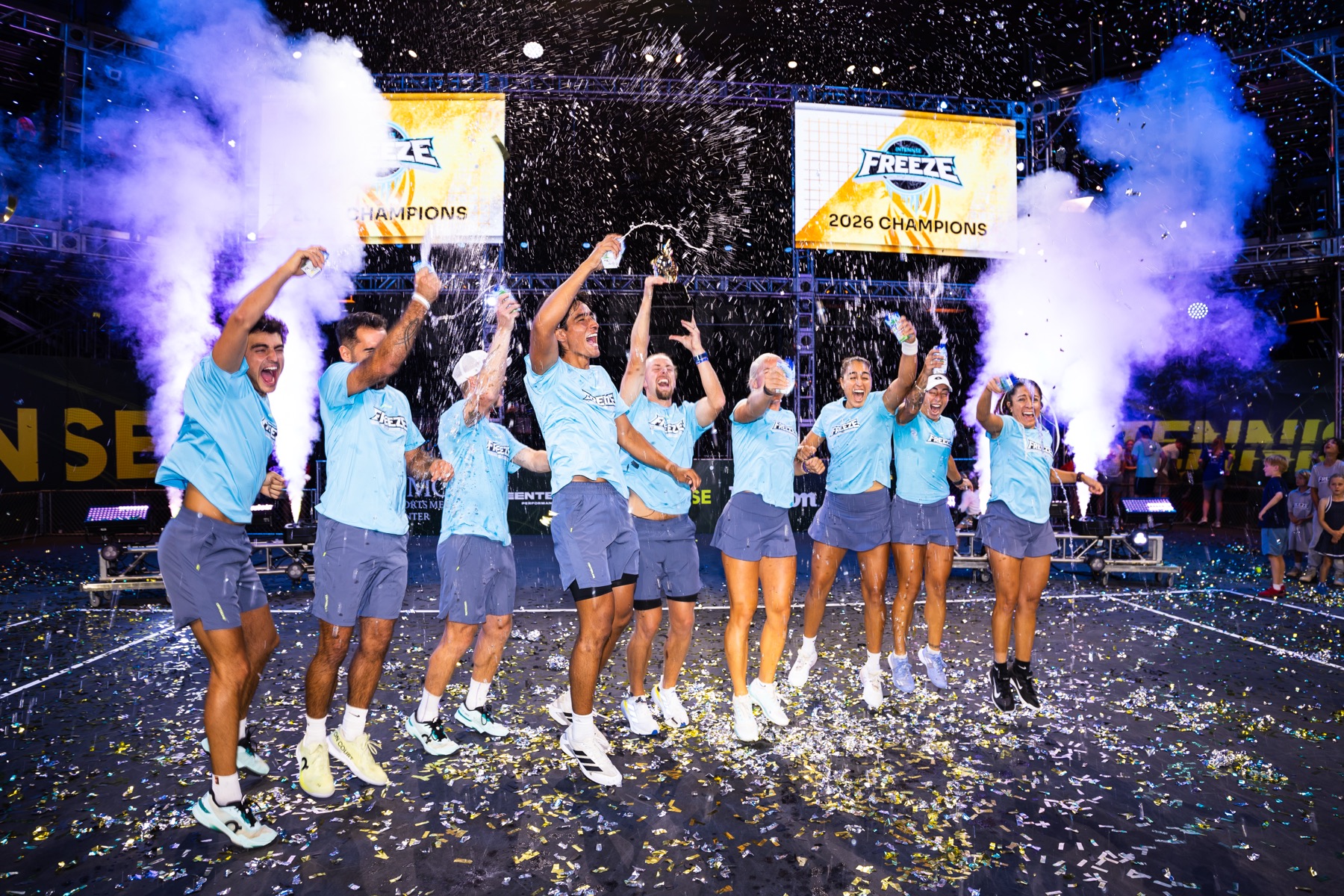
Team Inferno · For a city that runs hot · September 2026
“Not a dog-and-pony show.”
That is Terrell Owens explaining why, on the day he was enshrined in the Pro Football Hall of Fame, he held his own ceremony at his old university instead. He is the only inductee ever to do it. He is also the Pulse Partner of a professional tennis team called the Inferno, which tells you most of what you need to know about both of them.
Terrell Owens · Pulse Partner, the Inferno · 4 August 2018
In the stands, Atlanta · Season 2
A gender-balanced Professional Team Tennis League
Eight playing weeks in the middle of the summer. Switch the view to see the same season against the American sports year, or against the college calendar our players come from.
Where our players have been on the tour, and where they sit on the rating that covers everyone. The blue diamond is the league’s own MVP race, on its own scale.
UTR: our players against the tour’s
Down to the wire; Sudden Death
Two Arcs that finished a point apart. Each clip picks up in the closing minutes, with the full Arc a click away.
Sudden death, level at 142
The final three minutes of Freeze v Rise, 20 June. The clock runs out with the teams tied, and the next point decides it: 143–142.
Match Center ↗One point, one minute left
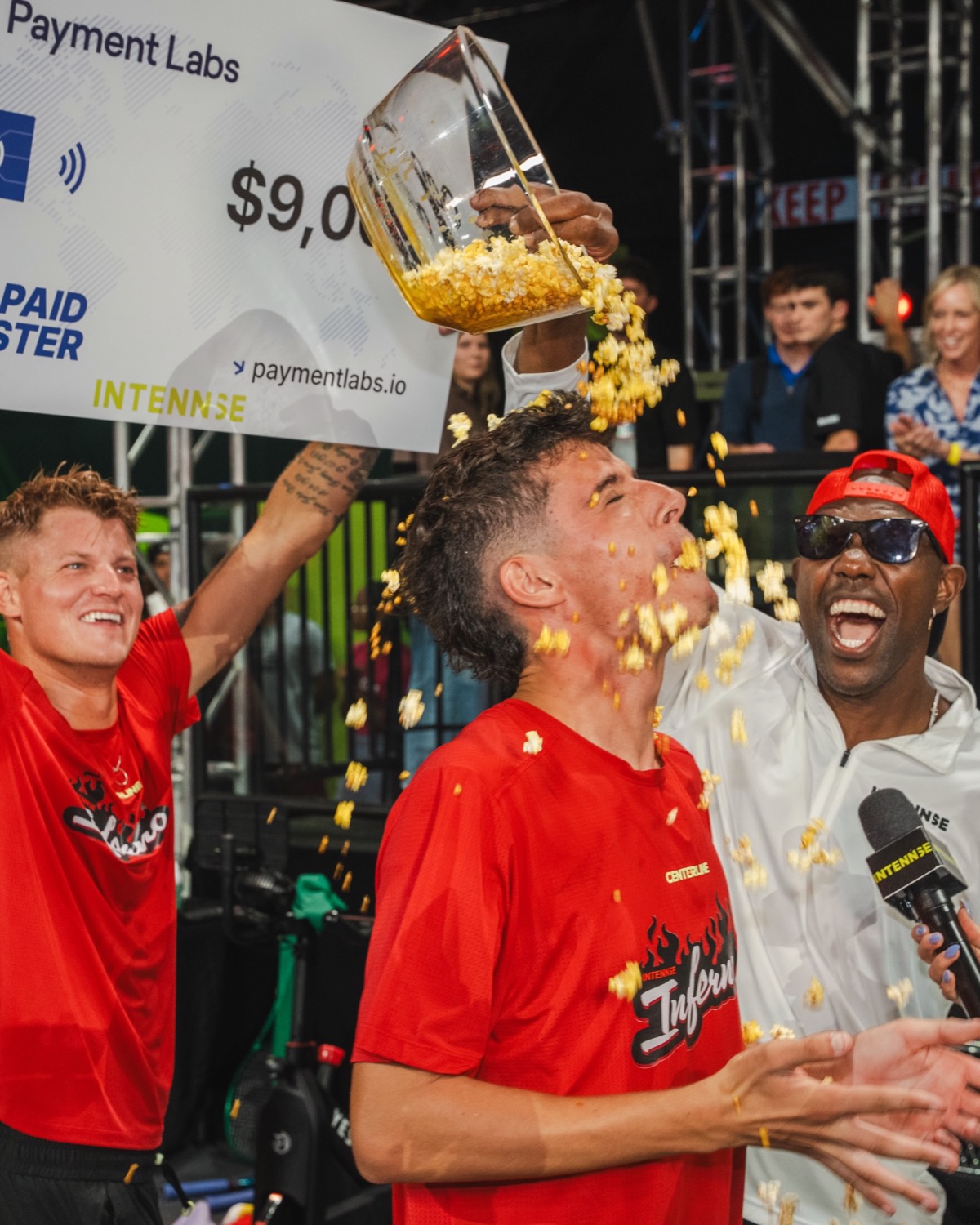
The final minute of Outriders v Inferno, 25 June. It finishes 150–149, with the winner’s cheque on court.
Match Center ↗Two points that flipped the score
One from the net, one from the low camera. Each is about twenty seconds, and each one changed the scoreboard.
Low angle, the final Bolt
The last play of the Bolt from the low camera: a two-pointer that takes the Sting from 86–87 to 88–87. 22 seconds.
Match Center ↗Mixed doubles, last seconds
Dalayna Hewitt’s two-pointer in the closing seconds against Rise, 15 July — 156 to 158, level. 18 seconds.
Match Center ↗■ The idea
Tennis calls its manners refinement. Houston calls refinement an industry.
Thirty-four Texas refineries run 6.1 million barrels a day — a third of everything America refines. The Gulf Coast handles more than half. The whole civic identity of the place is taking something raw and making it refined, at temperatures that would embarrass a tennis crowd.
Tennis has spent a century using that word for its own behaviour. The Inferno is what happens when you refine something and then set it alight.
The numbers under the joke
Texas operates 34 refineries at 6,134,650 barrels per calendar day, 33.8% of total US refining capacity. The Gulf Coast runs 58 refineries at 54.4% of the national total. The Greater Houston Partnership puts the Houston region alone at 15.3% of US refining capacity. ExxonMobil’s Baytown plant alone runs 560,640 barrels a day. Figures from the US Energy Information Administration, 1 January 2026.
The Houston Ship Channel runs fifty miles inland and anchors one of the two largest petrochemical complexes on earth. Port Houston is the country’s number one port by international waterborne tonnage.
■ The name
The Inferno was drawn for Phoenix. It belongs anywhere the heat is part of the story.
Every team in the league was named before any of them had a home market. The Inferno was sketched for the desert. But the name is not a postcode — it belongs in any city where the summer is a personality trait, and the charter that puts it in one carries the right to rename and rebrand it for that city. Houston makes the strongest case. Phoenix, Las Vegas, Dallas and Tampa can all argue.
Phoenix is hotter. Houston is heavier.
Being honest about it: Phoenix wins on the thermometer and it is not close. Its July average high is 106.5°F against Houston’s 94.5°F, and it spends 111 days a year above 100°F to Houston’s 4.6.
Houston wins on everything you actually feel. Summer mornings average over 90% humidity, with a July dew point of 72°F; Phoenix sits near 19% in June. Phoenix is an oven. Houston is a room you cannot leave.
■ The window
Houston’s ballpark opens its roof in April and May. Then it gives up.
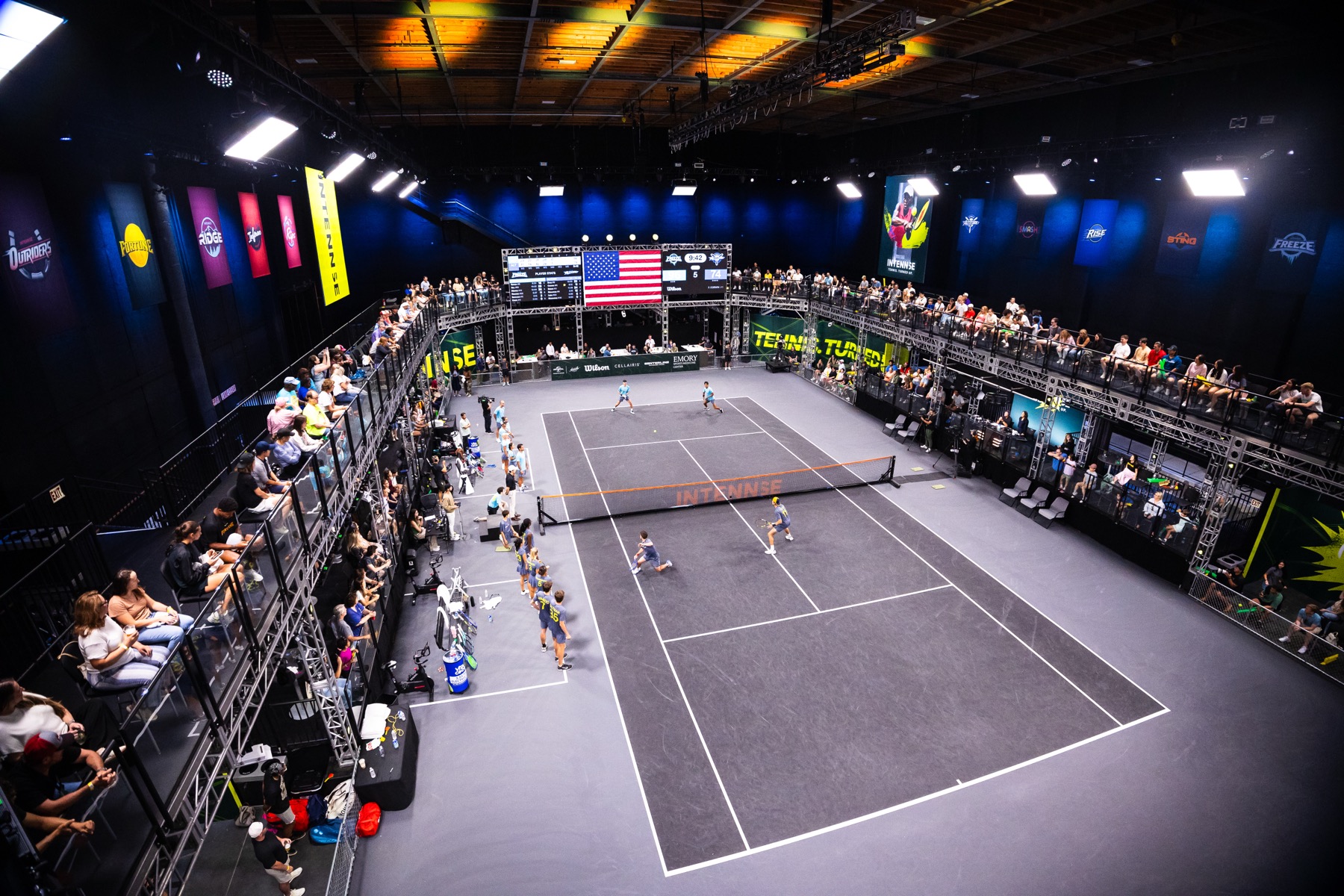
The Astros play with the roof open for two months a year, before the summer arrives and the city moves indoors for the duration. Our season is those exact weeks — June into the first days of August — played indoors, at night, in air conditioning, in about an hour and forty minutes.
A market where summer drives everyone inside is not a problem for an indoor summer league. It is the entire reason to be there.
■ The market
The fifth-largest metro in America, and it is still being fought over.
Two ownership groups are currently competing to put an NHL franchise in Houston at a reported expansion fee starting around two billion dollars. The WNBA is bringing the Comets back in 2027. This is a metro of 7.9 million that grew 10.6% in five years, the sixth television market in the country, and it is still short of major-league teams. Nobody behaves this way about a saturated market.
And it is already a tennis city
The US Men’s Clay Court Championship has been played since 1910 and has been in Houston since 2001, at River Oaks Country Club since 2007. It is the only ATP Tour event left in the United States played on clay.
Houston has also hosted the men’s season-ending championship three times — 1976 at The Summit, and 2003 and 2004 outdoors at the Westside Tennis Club, two of only three times that event has ever been played outdoors.
Underneath the professional game: three municipal tennis centres carrying 60 lighted courts between them, and roughly 200 more in neighbourhood parks. Rice fields men’s and women’s programmes at a 600-seat tennis centre.
■ The team on offer
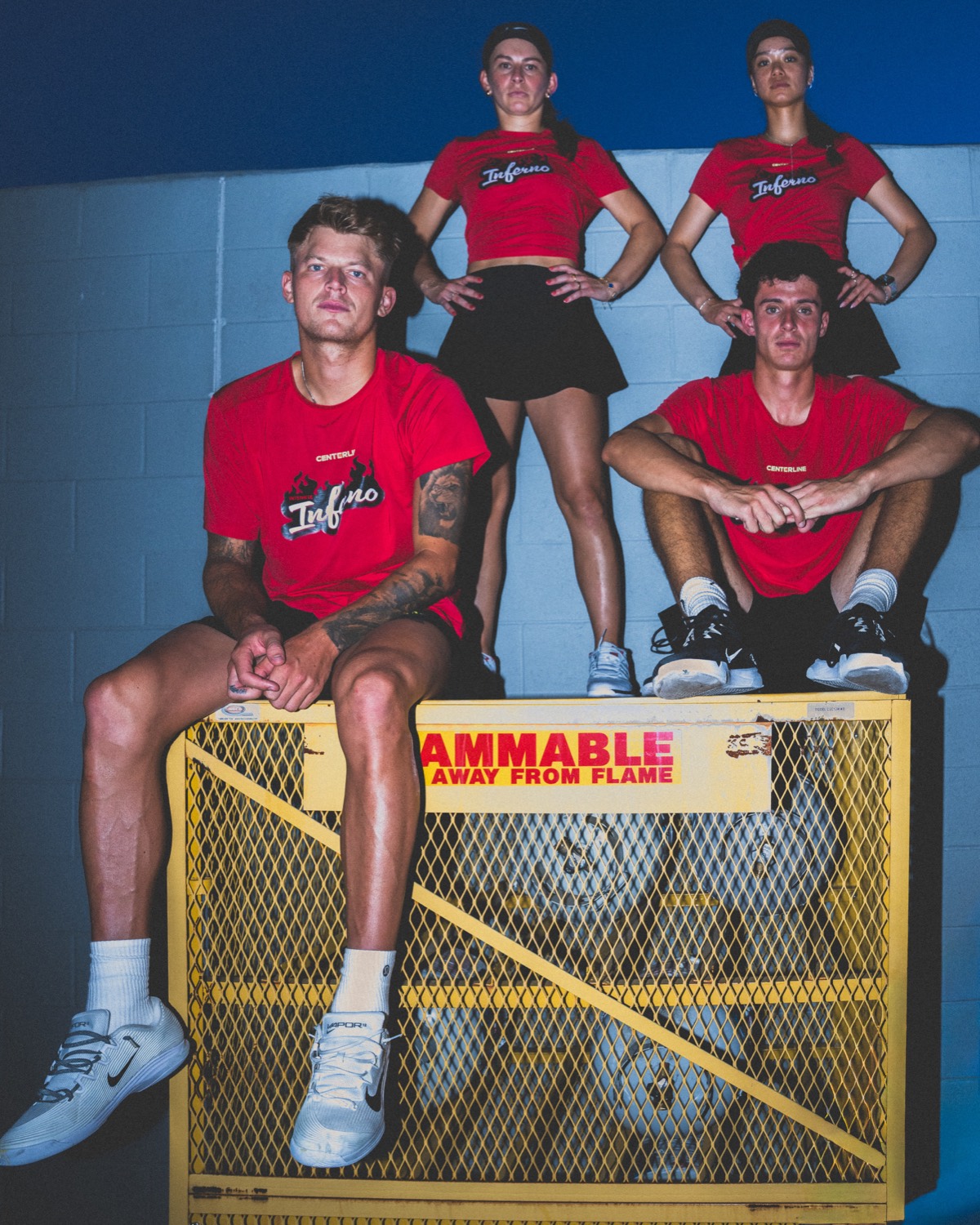
The Inferno reached the semi-finals and lost an Arc by a single point.
Usue Arconada carries a career high of 130 — two places outside the draw of a Grand Slam, and the highest of any woman in the league — and finished third in the 2026 MVP race. Jamie Connel came straight out of Florida State and finished eighth. Naomi Cheong came straight out of USC. One of the four clips at the top of this page is the Inferno losing 150–149 on the final point of the night.
Two of the six players who came into this league directly from college are on this roster.
■ The partner
Third all-time in receiving yards. Third in touchdowns. First in refusing the polite version.
Terrell Owens caught 1,078 passes for 15,934 yards and 153 touchdowns across fifteen seasons, six Pro Bowls and five first-team All-Pro selections. Only Jerry Rice and Randy Moss have scored more receiving touchdowns. He went into the Hall of Fame with the class of 2018 — and marked it in an arena at the University of Tennessee at Chattanooga, where he had played, in front of about three thousand people.
“I wanted to take a stand so the next guy coming after me will not have to go through what I, and others, have gone through.”
Terrell Owens · 4 August 2018
He dedicated it to everyone who had been bullied, misunderstood or overlooked. A team called the Inferno could not have found a better fit if it had gone looking.
■ What Season 2 did in Atlanta










A season that already sells.
Ten teams, eight weeks, fifty-one matches. Season 2 closed on 1 August with Freeze beating Outriders 137–130 in front of a full house.
The local business
By midseason, attendance was more than four times the year before and had already passed the whole of 2025. Thirteen sponsors signed, twelve of them through relationships already in the city, with Atlanta-based Cellairis as Founding Partner. The average ticket sold for $52, and team merchandise outsold league merchandise.
Eleven community events drew 770 people off the couch and onto a court. Those are the numbers a local owner inherits and builds on.
The Rules of INTENNSE, explained · 2:04
Nearly 8,000 fans through a 500-seat arena.
Average across forty airings on Peachtree; the best single Arc drew 116,000.
Record live concurrents across the final series.
Two broadcast, two RSNs, seven FAST, three streaming — 60% of watch time on TV.
■ Someone inside the game said so first
USTA Atlanta’s executive director coached a roster in Season 2, then wrote about it.
“Innovative, fast-paced, co-ed team format challenged our players in new ways while creating an electric atmosphere that brought a fresh energy to the game.”
Amy Bartlett O’Connell · Executive Director, USTA Atlanta · 31 July 2026
What else she said
She coached eight INTENNSE athletes through the 2026 season with the Outriders, and wrote about it on her own feed on Championship Weekend. We didn’t commission it and we didn’t pay for it.
On the people behind it: “I also continue to be amazed at the talented staff that Intennse has put together… It is a remarkable team that believes in the product and have fun while doing what they love.”
And she closed with: “I truly believe we’re only seeing the beginning of INTENNSE.”
■ What an owner holds
A ten-year charter, for the territory you choose.
Owners hold an exclusive Team Charter: MLS-style, geographically bound economic rights, not a traditional franchise. Ten years, renewing in five-year terms.
The league keeps
- Game
- Format, rules, schedule, officiating
- Brand
- League marks and national sponsorship
- Rights
- Media and data rights
The owner holds
- Team
- Operations and team marks in the territory
- Revenue
- Local sponsorship, ticketing, hospitality, activations
- Share
- Team merchandise, and a share of pooled league revenue
2026–27
The league operates the team and secures venues while the owner learns the business from inside it.
2028
Operations transfer. The owner appoints a GM, takes ticketing, hospitality and venue, and inherits a community playbook proven over three years in Atlanta.
2029 on
Scale — and a share of the fees from every charter the league sells after the initial offering.
How the economics are built
The owner keeps the large majority of the revenue the team earns locally. Separately, a share of league revenue is pooled and distributed across the teams, so an owner participates in the league’s growth as well as the team’s. From 2029, owners also share in expansion fees as the league adds cities: ten teams in 2027, a home market for every team by 2028, and a market we believe will carry thirty or more teams by 2035.
We’ll be straightforward about what kind of investment this is. It is a franchise-value investment first, and the operating model takes several seasons to turn cash-positive. We’ll walk you through that model, line by line, in the room rather than on a page.
■ What early looks like
The first owners in a league buy the cheapest seats it will ever sell.
That is the pattern in every emerging league that lasted. Houston is watching two groups bid two billion dollars for the privilege right now.
What we are not claiming
Not every new league lasts, and nothing about the ones that did is a promise about this one. In Major League Pickleball, teams that changed hands for around $100,000 in 2021 were valued near $10 million two years later; other ventures of the same era are gone.
The argument is only this. If team tennis becomes a real league in America, the charters sold before 2029 will have been the cheap ones. We think Season 2 is the evidence that it will.
■ Who you would be building with
The people behind the league.
■ Pulse Partners, by team
■ Why we sent this
We’re looking for the Inferno’s owners.
A group who can name the city: people who know their own market’s tennis, and want the team that stays in it.
Where an hour could lead
We’ll bring the charter, the model and the transition plan, and answer every question about them. If it’s worth a second hour, we’d rather it were at Windy Hill with Marcelo than in a conference room.
The charter
Terms, territory and the path from league-operated to owner-operated, walked through in full.
The model
Revenue lines, breakeven and the years to cash-positive — the numbers we left off this page on purpose.
The team
An afternoon at the home club, with the coach and the players, before Season 3.